The Zodiac Ciphers
November 6, 2026 · Cory
I've covered a lot of cold cases, but nothing gets under my skin quite like the Zodiac. Between 1968 and 1969, a phantom stalked the San Francisco Bay Area, targeting couples on lonely roads and a cab driver in the city. But the murders were only half the story. The killer craved the spotlight, taunting police and the public with a bizarre trail of letters, bomb threats, and complex cryptograms sent directly to local newspapers. In this episode, we are walking through the confirmed timeline of the Zodiac's terrifying reign. We will look at the brutal attacks that left five dead and two wounded, the desperate race to decode his ciphers before he struck again, and the chilling reality that some of those messages remained unsolved for over fifty years. Grab your snacks and settle in, because we are diving into one of the most infamous mysteries in American history.
Follow this case Court dates, rulings and arrests by email, each checked against the article that reports it.
Read the full transcript (57 sections · tap any line to jump the player there)
This transcript is the episode script as written and fact-checked, timed to the recording. Timestamps are approximate within a sentence.
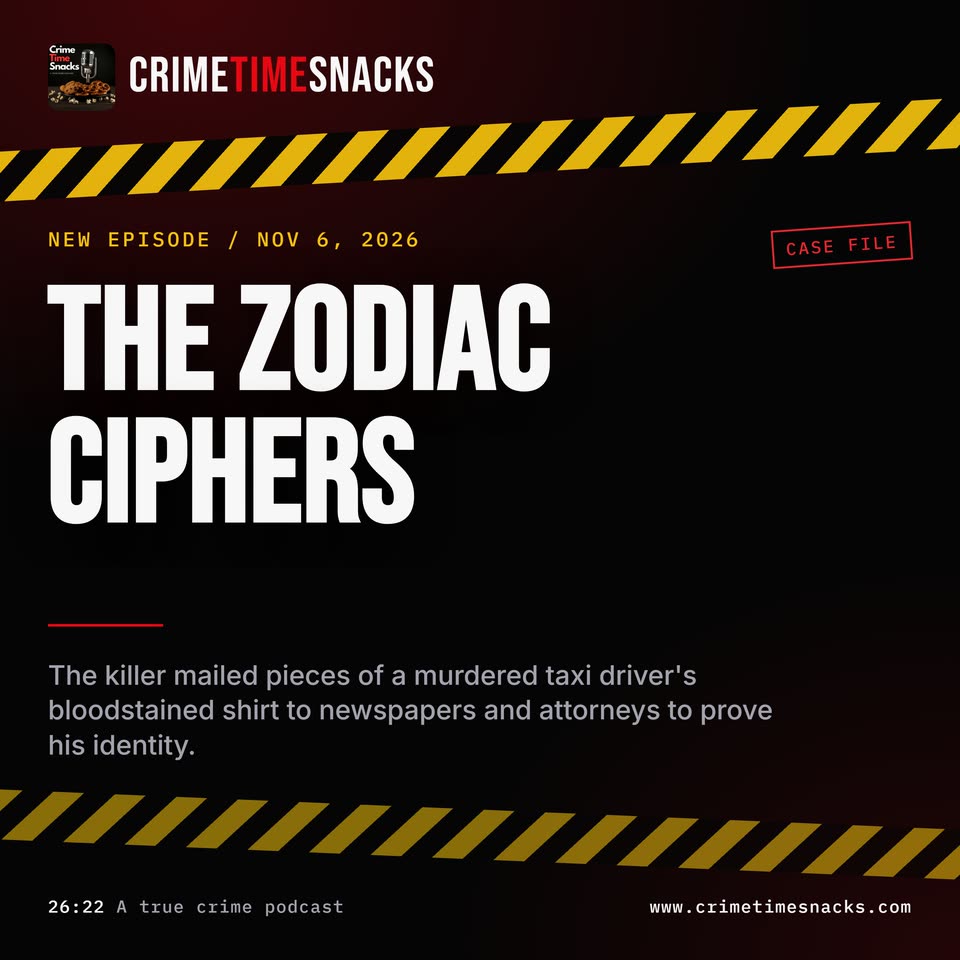
0:05 What's up guys, welcome back to CrimeTimeSnacks. The killer mailed pieces of a murdered taxi driver's bloodstained shirt to newspapers to prove he was the killer. Two days after a cab driver named Paul Stine was shot in San Francisco, the killer mailed a letter to the San Francisco Chronicle taking credit for the crime. Tucked inside that envelope was a bloody scrap of Stine's shirt. It was undeniable proof that the person writing the letters was the person standing at the crime scene.
0:29 We are looking at the case of an unidentified serial killer who terrorized the San Francisco Bay Area. The official record shows he murdered at least five people. He claimed in his letters to have killed thirty-seven, but investigators have only definitively linked him to a handful of victims. The confirmed, fatal attacks spanned a relatively short timeline, starting in December 1968 and ending in October 1969. The evidence shows the killer targeted three young couples and one lone male cab driver.
0:55 He did not stay in one jurisdiction, operating instead across rural, urban, and suburban settings. The attacks were spread across Benicia, Vallejo, unincorporated Napa County, and the city of San Francisco. While five people tragically lost their lives, two of the victims actually survived their injuries. The case became infamous because of how the killer communicated with the public. On August 1, 1969, three different Bay Area newspapers received near-identical handwritten letters without return addresses.
1:24 The writer took credit for the local attacks and included three parts of a complex cipher. He demanded the codes be printed on the front pages, threatening to cruise around all weekend killing lone people in the night if the papers refused. A Vallejo police chief publicly doubted the letters were written by the actual murderer and asked for more facts. The killer happily obliged. On August 4, a newspaper received a second letter that started with the greeting, "Dear Editor This is the Zodiac speaking."
1:51 That was the debut of the Zodiac persona, and the first time the killer called himself by that nickname. In that follow-up letter, he provided minute details about the crime scenes that only the perpetrator could have known. He explained exactly how he taped a flashlight to his gun to aim easily in the dark. We are going to look at what the case file actually shows about those nights. The first confirmed attack happened five nights before Christmas. On December 20, 1968, high school students Betty Lou Jensen and David Arthur Faraday went on their first official date together.
2:21 Betty Lou was sixteen and went to Hogan High School. David was seventeen and went to Vallejo High School. They promised Betty Lou's parents they would be home by 11 p.m. David picked Betty Lou up at 8:30 p.m. The couple visited one of her friends first. Sometime after 9 p.m., they drove out to the outskirts of Vallejo. They parked at a well-known lover's lane on Lake Herman Road, right inside the Benicia city limits. They pulled Faraday's Rambler onto a gravel runoff near the gate to a water pumping station.
2:48 We know they sat there for a while. Between 10:15 and 10:30 p.m., a passing motorist noticed their car parked in that spot. Another driver spotted the couple parked in that exact same spot at 11 p.m. The timeline gets incredibly tight right here. Between 11:05 and 11:10 p.m., someone attacked them. Investigators determined the assailant parked his vehicle about ten feet away, alongside the passenger side of David's car. He got out and fired several shots at the Rambler as he walked around to the driver's side.
3:19 Bullet holes in the roof and back window show the killer likely fired warning shots to force the teenagers out. None of those initial shots hit David or Betty Lou. The couple scrambled to escape through the passenger door. Betty Lou made it out. As David was exiting, the killer shot him in the head with a .22-caliber pistol. The shooter then chased Betty Lou as she ran for her life. He fired six shots at her back, and five of them hit her. Police theorized this entire attack took just two to three minutes.
3:45 At 11:10 p.m., another motorist spotted the bodies and called the police. Betty Lou was already dead. David was found next to the car, still breathing, but he died later at the hospital. The killer left shell casings identified as Winchester Western Super X copper-coated ammunition. Ballistics indicated the weapon was possibly a J.C. Higgins Model 80 semiautomatic pistol. There were no witnesses. The scene yielded no usable tire tracks or footprints. Police had no viable suspects and could only guess that a stranger targeted the teenagers at random.
4:15 The police investigation into the Lake Herman Road murders hit a wall almost immediately. The attacker left no usable tire tracks or footprints in the gravel. Investigators could only deduce that a stranger had targeted the teenagers at random. Despite an intense search in the following months, no viable suspects emerged. The media covered the murders extensively, but the case went cold. That changed seven months later. Around midnight on July 4, 1969, he struck again. The victims were twenty-two-year-old Darlene Ferrin and nineteen-year-old Michael Mageau.
4:46 Darlene was married, but the two went on a date that night anyway. They knew each other from a local restaurant where Darlene worked. The timeline that night started late. After 11:30 p.m., Darlene received a phone call at her house. She left and arrived at Michael's place around 11:50 p.m. Immediately after they drove away from his house, the couple noticed a man following them in a light-colored car. Darlene drove out of Vallejo, heading in the direction of Lake Herman Road.
5:12 Just before midnight, she turned into an empty parking lot at Blue Rock Springs Park. This was another known lover's lane. It was located just two miles from where David and Betty Lou had been murdered. Darlene parked about seventy feet from the lot entrance. Another vehicle pulled in and parked eighty feet to their left. The driver turned his headlights off and sat completely motionless in the dark. Michael asked who the man was, but Darlene told him not to worry. Suddenly, the stranger tore out of the parking lot.
5:37 Five minutes later, that same driver returned. He shined a flashlight directly into Darlene's vehicle as he walked up. Thinking he was a police officer, the couple rolled down Michael's window to speak with him. The stranger never said a word. He raised a nine-millimeter pistol and fired directly into the car. One bullet hit Michael in the right arm, and another struck Darlene in the neck. Michael desperately tried to get out, but his door handle was missing. The shooter walked back to his own car, opened the door, and did something Michael could not see.
6:04 While Michael was still struggling to exit, the stranger returned. He shot both victims two more times each, then hurried back to his car and sped off. A caretaker at a nearby golf course reported hearing the gunshots around 12:10 a.m. The perpetrator left no clues at the scene that could be traced back to him. Darlene was fatally wounded, but Michael survived his injuries. Right after the shooter sped off, three teenagers pulled into the lot. They saw the bullet-riddled car and immediately went for help.
6:32 Police arrived at the scene at 12:20 a.m. Darlene was rushed to Kaiser Foundation Hospital, but she did not make it. She was pronounced dead at 12:38 a.m. Michael survived the attack. That made him one of only two people to survive the confirmed attacks. Because he lived, investigators finally had a living eyewitness. Michael described the shooter as a heavyset White man, standing about five foot eight. He estimated the man weighed around two hundred pounds. The attacker had a large face, curly light brown hair, and wore dark clothing without glasses.
7:02 Those details gave police a basic profile, but it was not enough to zero in on a suspect. Then, the killer made a move that changed the entire investigation. At 12:40 a.m., just two minutes after Darlene was pronounced dead, the Vallejo Police Department received another call. The call came from a payphone located just two blocks from police headquarters. The man on the line stated he wanted to report a double murder. He gave directions to the park and told the dispatcher the victims were shot with a nine-millimeter Luger.
7:31 Before hanging up, the caller added one final chilling sentence. He said he also killed those kids last year. The connection between the victims might have gone deeper than a random targeting. Darlene actually knew Betty Lou and David. She lived less than two blocks from Betty Lou. There is also debate in the case file about whether Darlene knew the man who shot her. Michael gave conflicting accounts to the police. At the hospital, he claimed he did not know the murderer. Later on, Michael said the assailant's name was Richard.
7:57 Darlene's sister said one of Darlene's boyfriends was named Richard. Investigators have never proven a definitive prior relationship between Darlene and the killer. There is a surviving photograph of Darlene posing with an unknown man. Police believe the picture was taken in San Francisco in 1966 or 1967. The man in that photo closely resembles the composite sketch of the killer that was generated later. The first letters were dated July 31, 1969, and they reached the San Francisco Chronicle, the San Francisco Examiner, and the Vallejo Times-Herald on August 1.
8:28 The writer explicitly stated he was the killer of the two teenagers from the previous Christmas. He also took responsibility for the recent July 4 attack at Blue Rock Springs. To prove he was the actual shooter, the letters contained specific details about the crimes known only to police. But the most infamous part of the mailing was the puzzle tucked inside each envelope. Each contained one-third of a dense, handwritten code. When investigators combined the pieces, they formed a massive block of strange characters and shapes.
8:55 This is known in the case file as the Z408 cryptogram, named for its four hundred and eight symbols. The killer claimed his actual identity was hidden inside this cipher. The authorities realized they were dealing with someone who treated murder as a public game. In his August 4 letter, the writer said that when they cracked the code, they would have him. The Z408 cipher was decrypted in 1969, just days after the papers printed it. The decoded message did not give the authorities a suspect.
9:20 Instead, it revealed a deeply disturbing manifesto about why he committed the murders. The writer stated that he liked killing people because it was more fun than hunting wild game in the forest. He called man the most dangerous animal of all. The translation exposed a highly delusional motive for the violence. The killer wrote that when he died, he would be reborn in paradise. He claimed that all the people he murdered would become his slaves in the afterlife. That was his stated reason for refusing to reveal his true identity in the text.
9:48 He wrote that giving his name would allow the police to stop his collection of slaves. The decoded message was deliberately strange and riddled with bizarre spelling errors. He spelled the word paradise with a 'c' and the word forest with two 'r's. The case file shows the follow-up letter on August 4 was specifically mailed to the San Francisco Examiner. That was the first time the writer introduced himself with the phrase, "This is the Zodiac speaking." But he also included a visual signature that would become just as infamous.
10:16 He had signed every letter, from the very first ones, with a symbol resembling the crosshairs of a gunsight. It was a simple circle with a cross drawn straight through it. That crosshair mark became his official stamp. He used it to sign off on a string of taunting messages that would continue for years. Between 1969 and 1974, the killer mailed over twenty letters. He sent them to local newspapers, police departments, a Chronicle reporter named Paul Avery, and a prominent attorney named Melvin Belli.
10:42 Most of the envelopes were postmarked in San Francisco or a nearby town called Pleasanton. Four of those mailings included complex cryptograms, and two of them remain unsolved today. I told you the first cipher was cracked quickly. The people who actually solved it were a high school teacher named Donald Harden and his wife, Bettye. They figured out the killer's twisted manifesto just days after the papers printed the code. Neither of them was a cryptologist. As the months went on, the letters grew stranger.
11:08 In July 1970, he wrote to the Chronicle complaining that people were not wearing Zodiac-themed buttons. Two days later, he mailed another letter parodying a song from the comic opera The Mikado. He started keeping a running score at the bottom of his notes, writing that the Zodiac had thirteen points and the San Francisco Police Department had zero. By March 1971, he sent a letter to the Los Angeles Times claiming he had killed seventeen people. Then he went completely silent for almost three years.
11:34 The next confirmed letter arrived in January 1974. He praised the movie The Exorcist, calling it a satirical comedy, and updated his score to claim thirty-seven victims. That 1974 note was his last confirmed message, but newspapers received suspicious letters, before it and for decades after it, that were never confirmed as his. In 1973, a letter sent to an Albany, New York paper promised another killing and included a short code. The FBI deciphered it, but the handwriting was not a definitive match.
12:03 In 2007, an American Greetings Christmas card postmarked in 1990 in Eureka was discovered in the Chronicle's photo files, with a photocopy of two post office keys enclosed. A forensic document examiner ruled the handwriting was inauthentic, but letters like these kept the investigation chaotic. The killer's next move happened in broad daylight. On September 27, 1969, twenty-year-old Bryan Calvin Hartnell and twenty-two-year-old Cecelia Ann Shepard were picnicking at Lake Berryessa.
12:30 That is a reservoir in unincorporated Napa County. They were sitting on a small island connected by a sand spit when Cecelia noticed a man watching them. The stranger stepped out from behind a tree and put on a black executioner's hood. He had clip-on sunglasses over the eye holes and wore a bib with that white crosshair symbol printed on the chest. He pulled a gun and told the couple he was an escaped convict. He claimed he needed their car and money to flee to Mexico. Bryan actually believed they were just being robbed.
12:58 The assailant handed Cecelia precut lengths of plastic clothesline and ordered her to bind Bryan. After she finished, the man checked the knots and tightened them himself before tying Cecelia up too. Then the record shows he put the gun away and drew a knife. He brutally stabbed the couple right there on the ground. Bryan suffered six stab wounds, and Cecelia took ten. The attacker left them there and hiked five hundred yards back to Knoxville Road. He walked right up to Bryan's car and took out a black felt-tip pen.
13:26 He drew his crosshair symbol on the door and wrote something underneath it. Back at the water, a fisherman and his son heard the couple screaming and went for help. Bryan managed to loosen Cecelia's ropes with his teeth, and she freed him. Napa County deputies arrived to find them both bleeding terribly. Cecelia was fully conscious and gave the officers a detailed description of the hooded attacker. Ambulances rushed both victims to Queen of the Valley Hospital in Napa. Cecelia slipped into a coma during the transport.
13:52 She never regained consciousness and died from her injuries two days later. Bryan Hartnell survived the brutal stabbing and was able to tell investigators exactly what happened. The killer was not done for the day. He drove twenty-seven miles from the crime scene to a payphone in downtown Napa. At 7:40 p.m., he called the local sheriff's department to report a double murder and confessed to the crime. He left the receiver dangling off the hook and vanished. Detectives lifted a wet palm print from that receiver, but they could never match it to a suspect.
14:19 Investigators also learned that other people at the lake had seen a suspicious, heavyset man earlier that afternoon. Three women who had seen a strange man there, possibly the killer without his hood, worked with a newspaper photographer to create a composite sketch. It was a solid lead, but the case file shows it was not enough to make an arrest. The last confirmed murder in the case file happened exactly two weeks after the Lake Berryessa stabbings. On October 11, 1969, the killer struck in the Presidio Heights neighborhood of San Francisco.
14:46 His target was twenty-nine-year-old Paul Lee Stine. Paul was a doctoral student who drove a taxi. Around 9:40 p.m., the killer hailed the cab. He asked to be taken to Washington and Maple streets in Presidio Heights. When they arrived, the passenger asked Paul to drive one block further to Washington and Cherry. At 9:55 p.m., the man shot Paul in the head with a handgun. He then took the driver's wallet and car keys. Three teenagers were watching from a house directly across the street.
15:13 The streetlights gave them a clear view of the killer's face. They watched the man wipe down the cab and rifle through Paul's clothes. The record shows he left behind two partial fingerprints from his right hand. The kids immediately called the police. They described the suspect as a husky White man wearing a dark jacket. The dispatcher mistakenly alerted patrol cars to look for a Black suspect. Just two minutes after the call, two officers responded to the area. They spotted a White man in dark clothes walking north toward the nearby Presidio army base.
15:42 Because of the dispatcher's error, the officers did not consider this man a suspect. What happened next is disputed. By the killer's own later account, they pulled up alongside him, asked if he had seen anything unusual, and he sent them east after a man waving a gun. Officer Fouke's memo says the man was never stopped at all. When police got to the cab, Paul Stine was declared dead. They canvassed the area, but the shooter had already slipped away. Investigators initially assumed the motive was a simple robbery.
16:09 That theory fell apart two days later. On October 13, the killer mailed a letter to the San Francisco Chronicle claiming responsibility for killing the taxi driver. To prove it, he included that bloody swatch of Paul's shirt. The killer also used the letter to make a terrifying new threat. He claimed he was going to shoot out the tire of a school bus and kill the children as they exited. Meanwhile, the teenage witnesses helped a police artist make a composite sketch of the man they saw at the cab.
16:34 The two patrol officers realized the man they had seen near the scene may have been the killer, and they helped develop a sketch too. San Francisco detectives Bill Armstrong and Dave Toschi were assigned to investigate the murder. Toschi eventually took over the case by himself. He spent years tracking down leads and filled eight filing cabinets with potential suspects. Despite the sketches and the fingerprints, the killer remained unidentified. The police were drowning in suspects, but the killer just kept writing.
17:01 On November 8, 1969, the San Francisco Chronicle received another piece of mail. Inside the envelope was a greeting card that investigators call the Dripping Pen card. The sender wrote that he thought the police would need a good laugh. Along with that card was a brand new cipher made up of three hundred and forty characters. It is known in the case file as the Z340 cryptogram. The killer wanted to prove he was smarter than the authorities, and this puzzle proved incredibly difficult to crack.
17:28 Law enforcement and amateur cryptologists tried to decode that message for decades. It sat completely unsolved for over fifty years. The Z340 cryptogram was finally decrypted in 2020. But back in the fall of 1969, the authorities had absolutely no idea what the message contained. They did not have to wait long for more taunts. The very next day, the killer reached out again. On November 9, the Chronicle received a massive, seven-page letter. The writer bragged that the police would never catch him because he had been too clever for them.
17:57 In it, he claimed two policemen stopped and questioned him just three minutes after he shot Paul Stine, and that he sent them off after a man waving a gun. Two patrol officers had in fact seen a man walking away from the area that night. But Officer Fouke's memo says they never stopped him, so the only account of that conversation is the killer's own. The letter also contained a terrifying new visual. The killer drew a detailed diagram of a bomb. He threatened to use it to blow up a school bus.
18:21 Three days later, on November 12, the Chronicle printed an edited version of the letter to warn the public. The writer also used that mailing to update his supposed body count. He claimed to have killed seven people. The official record links him to five deaths and two survivors, across four attacks. And he was not done writing. Exactly one year after the Lake Herman Road murders, on December 20, 1969, he reached out again. He mailed a letter to Belli. The note itself was strangely desperate.
18:49 The writer pleaded for help, claiming he was drowning and could not remain in control for much longer. By the spring, the Zodiac was back to taunting the press with puzzles. In April 1970, he sent a letter to the San Francisco Chronicle that started with the phrase, 'My name is.' He followed that opening with a short, thirteen-character cipher. The case file calls this the Z13 cryptogram. Because it is so short, experts say it is practically impossible to determine if any proposed solution is correct, and it has never been definitively solved.
19:18 In that same letter, he denied responsibility for a recent police station bombing. He also included another diagram of a school bus bomb. He updated his score to claim ten victims. Two months later, in June 1970, the Chronicle received another unsolved code. The killer mailed them a Phillips 66 roadmap. He drew his crosshair symbol over Mount Diablo to act as a compass rose, instructing police to set zero to magnetic north. He included a thirty-two-character cipher, known as the Z32.
19:46 The Zodiac claimed the map and the code would reveal where he had buried a bomb. Investigators never located any explosives. The bizarre mailings just kept coming. Throughout 1970, the Zodiac sent a steady stream of greeting cards and letters to the press. On October 7, the Chronicle received a card with thirteen holes punched across it and a small cross reportedly drawn in blood. On October 27, Avery received a Halloween card signed with the killer's crosshair symbol. A handwritten note inside read, 'Peek-a-boo, you are doomed.'
20:16 The threat was taken seriously, and the Chronicle covered it on their front page. Avery actually refused police protection and started carrying a pistol himself. His colleagues at the paper even started wearing buttons that read, 'I Am Not Avery.' The killer's correspondence took a strange turn in March 1971. We already know he used that note to claim seventeen victims, but he also included a direct taunt to law enforcement. He explicitly wrote that he was crack proof. The envelope itself might have contained a hidden joke.
20:44 The case file shows it was postmarked from Pleasanton, California. Zodiac expert Tom Voigt theorized this was a deliberate choice by the sender. The killer likely thought it was funny to mail an unpleasant threat from a town with that specific name. After that Los Angeles mailing, the Zodiac vanished from the public eye. Investigators had to wonder if the man behind the crosshair symbol was dead, incarcerated, or simply done with his twisted game. The answer finally arrived in the winter of 1974.
21:10 In a letter to the Chronicle postmarked January 29, 1974, he finally resurfaced. It is now known as the Exorcist letter, and it marked the official end of his verified correspondence. He used this final confirmed message to update his murder count to thirty-seven people. But the rest of the page was just as bizarre as his earlier mailings. At the very bottom of the page, he drew an unusual, unexplained symbol. It was a cryptic final signature from a phantom who was about to disappear for good.
21:39 The abrupt end to the confirmed letters left investigators with a massive psychological puzzle. Psychiatrist David Van Nuys reviewed the case and proposed a fascinating theory. He suggested the killer might have suffered from multiple personality disorder. Van Nuys theorized that this condition can actually lessen over time, which would explain the reduced intensity of the letters. Even though that was the last verified contact, the Chronicle kept receiving strange mail that year.
22:06 On February 14, a letter arrived claiming the Symbionese Liberation Army's initials spelled an Old Norse word for kill. On May 8, another note complained that the movie Badlands glorified murder. That one was simply signed by a citizen. Two months later, another anonymous letter complained about an antifeminist columnist named Marco Spinelli. The writer signed off as the Red Phantom, red with rage. The handwriting, tone, and sarcasm in these notes felt incredibly similar to the Zodiac's style.
22:34 But forensic experts could never definitively authenticate them, leaving the true end of the killer's timeline a mystery. When those first two teenagers were killed on Lake Herman Road, local newspapers covered the murders extensively. The police had no viable suspects and no usable footprints. That coverage completely exploded when the killer started mailing his demands directly to the newsrooms. You have to look at the timeline to understand why the editors actually published those bizarre messages.
23:01 The newspapers printed the killer's letters and his cryptograms. He explicitly threatened bombings and weekend murder sprees if the papers refused to put his words on the front page. The combination of cold-blooded murders, taunting letters, and those complex cryptograms made the case one of the most famous unsolved mysteries in American history. It was no longer just a local tragedy. The killer's terrifying persona quickly became a permanent fixture of popular culture. The ongoing mystery has been the subject of numerous books, documentaries, and movies over the decades.
23:33 It actually inspired the 1971 action film Dirty Harry right in the middle of the active investigation. Decades later, the case was the subject of the critically acclaimed 2007 film Zodiac. This intense public fascination created a completely new dynamic for local law enforcement to manage. The massive media exposure led to amateur detectives all over the world trying to uncover his identity. People became obsessed with cracking the unsolved ciphers and finding the man behind that crosshair symbol.
24:00 The search for his real name continues to be pursued by citizens today. Despite the intense public scrutiny, the case remains open in multiple jurisdictions. The California Department of Justice, the FBI, the city of Vallejo, and the Napa and Solano county sheriffs all maintain active files. More than half a century on, there are letters, sketches, and partial prints, and still no name. Thousands of men have been put forward as possible suspects over the last half-century. One researcher noted that fifty to a hundred new names are still suggested every single year.
24:31 Despite that massive volume of theories, police have only ever publicly named one man as a suspect. That man was Arthur Leigh Allen. He was a former elementary school teacher and a convicted sex offender. Some of his friends claimed he called himself by the killer's nickname and talked about shooting young couples in lover's lanes. People who suspected him also argued that the timing of his imprisonment lined up with the pattern of the Zodiac's letters. Police pursued him more than any other lead, for years.
24:57 None of it was ever tested in court. Police searched Allen's property several times, but they never arrested him. His fingerprints and handwriting could not be definitively linked to the Zodiac. A retired police handwriting expert, Lloyd Cunningham, said in 2009 that none of Allen's writing even came close. In the early two thousands, investigators developed a partial DNA profile from Zodiac letters that possibly belongs to the killer, and in 2002 San Francisco police said Allen did not match it.
25:23 True crime author Robert Graysmith wrote two books strongly suggesting Allen was the killer. Allen died in August 1992. He was never charged with any of the Zodiac crimes. With no new definitive leads, the investigation eventually stalled. In 2004, the San Francisco Police Department officially marked the case inactive. It sat in that dormant status for two years. Then, in 2006, the department reversed course and reopened its files. That decision brought San Francisco back in line with the other investigating agencies.
25:53 They are all still waiting for that one piece of undeniable proof. The search for the perpetrator's true identity continues well into the twenty-first century. No one has ever been arrested for the crimes. The confirmed victims, the bizarre ciphers, and the taunting letters are all part of the official record. Read the file. Form your own conclusion. That's it for this one. Thanks for hanging out with me. This has been CrimeTimeSnacks, and I'll catch you next time.